Warrior Equine – Supporting Positive Mental Health Through Horses
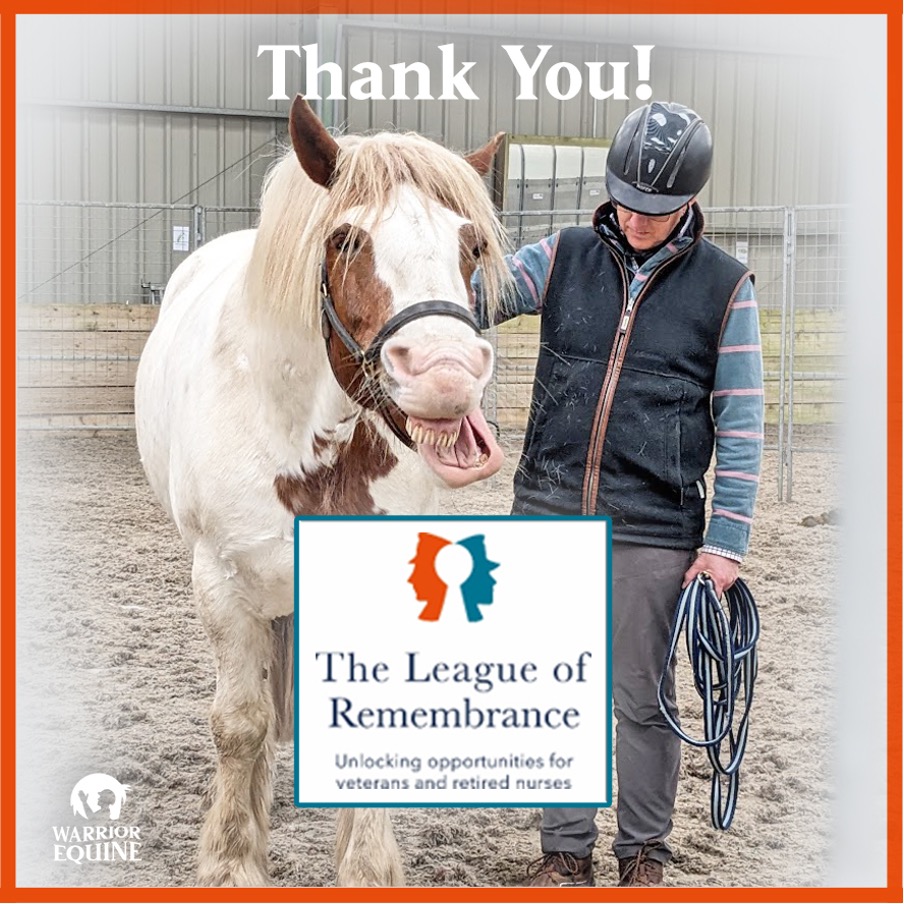
Trauma carries invisible weight, and for many Veterans living with PTSD or other psychological injuries, traditional therapies are vital, but not always sufficient. That’s why the League of Remembrance was honoured to fund three Veterans to attend a three-day programme at Warrior Equine, a not-for-profit community interest company specialising in equine-assisted coaching.
About Warrior Equine
Warrior Equine works primarily with Armed Forces personnel, veterans, and emergency services staff who have experienced severe trauma. Their team of experienced facilitators uses horses in structured programmes designed to help participants manage PTSD, anger, social withdrawal, and difficulties adjusting to civilian life.
Through groundwork and guided interaction, participants learn to regulate emotions, rebuild trust, and improve self-esteem. Horses respond instinctively to human behaviour, offering honest feedback that encourages participants to find calm, clarity, and confidence.
The organisation’s ethos is simple but profound: “Taking back control of emotions, rediscovering trust, self-esteem, and reigniting zest for life.”
The Impact
The three veterans that we supported engaged in a calm, supportive environment, where horses became both teachers and companions. Each session focused on emotional awareness, non-verbal communication, and resilience. The results were powerful: improved mood, reduced anxiety, and a renewed sense of belonging.
Feedback from participants across Warrior Equine programmes shows that equine therapy can spark real transformation. Many report greater emotional control, stronger coping mechanisms, and the confidence to reconnect with family and community.
“We’re delighted to have received a generous new grant from the League of Remembrance. They will be sponsoring places on our Mental Resilience programme for three veterans in 2025. Recognising and supporting all three branches of the services, these places will be allocated for 1 x Royal Navy, 1 x Army and 1 x RAF.
Our gratitude to the Secretary To The League, Maj Rob Thomas who visited a course earlier this year, and said “the best of luck with your on-going work – so vital and so much appreciated, by both ourselves and most importantly, by those who you help”.
Why It Matters
For veterans, healing from trauma is a journey, not a single step. By supporting places on Warrior Equine programmes, the League helps ensure that Veterans living with PTSD and other challenges have access to innovative, life-changing support.
Together, we are turning remembrance into action, supporting those who once served by offering them dignity, recovery, and hope.
Please kindly donate to Support More Programmes like this.
Cyril’s Story: Service, Discipline, and a Smile
in Volunteer Stories/by Rob ThomasCyril’s Story: Service, Discipline, and a Smile
Cyril began his journey of service in the late 1950s with the Royal Army Pay Corps during his National Service. After leaving the Army, he built a long career in retail, dedicating most of his working life to that sector.
In retirement, a chance conversation with a friend who volunteered for the League of Remembrance opened a new door. Intrigued, Cyril joined us in 2013 and has been a valued Remembrance Worker ever since.
Shanti’s Story: Giving Back With Gratitude
in Volunteer Stories/by Rob ThomasShanti’s Story: Giving Back With Gratitude
Shanti’s story is rooted in resilience and service. Her father was a volunteer in the British Army during the Second World War, stationed in Trincomalee, in what was then Ceylon (now Sri Lanka).
Following in those footsteps of service, Shanti built her own career as a teacher in Sri Lanka, where she taught for 18 years. When her home was destroyed during the civil war she, and her husband, Noel, moved to England to begin a new life.
They both quickly found work, Shanti as a civil servant, and Noel as a bookkeeper, while also volunteering in their local church. But life changed again when Noel faced serious illness, undergoing two major operations at St George’s Hospital, Tooting.
They were so grateful for the wonderful treatment Noel received at St George’s that they both began volunteering with the League of Remembrance, working as a general guide and information point at St George’s Hospital, helping patients, families, and visitors feel supported; and also providing guidance to fellow volunteers. Sadly, Noel passed away but, undeterred, Shanti now volunteers with her daughter, Naomi, at Work and Play Scrap Store, Wandsworth, sorting and recycling clothing for use by their local community.
Her story reflects gratitude transformed into action, and the spirit of remembrance made real through everyday kindness.
Mike’s Story: Easing Patient Worries
in Volunteer Stories/by Aron JohnstonMike’s Story: Easing Patient Worries
Mike spent 27 years in the RAF Medical Branch before working in civilian healthcare. After retiring, he became a volunteer in the Endoscopy Department at St George’s Hospital. Mike’s main job is to greet, and reassure, patients who feel nervous before their procedure, and to support their families. He makes drinks, and keeps everyone calm, helping them feel cared for, and listened to during what can be a a very difficult time for all.
Jill’s Story: Guy’s Hospital
in Volunteer Stories/by Aron JohnstonJill’s Story: Guy’s Hospital
Jill joined the volunteer service at Guy’s Hospital in March 2005, following retirement from general employment, as a result of a friend who worked at Guy’s mentioning that the hospital was looking for volunteers. Six years later, she joined us at the League of Remembrance.
Could you be a League of Remembrance volunteer? Get in touch.
Level Best
in Case Studies/by Aron JohnstonUnlocking Potential – Level Best Enterprises
Colchester-based charity Level Best Enterprises delivers meaningful life and work experience for young adults with learning disabilities (Trainees) in its café, art gallery, gardening and kitchen enterprises.
Through our partnership, supporting Trainee placements over five years, the League of Remembrance helps open doors to practical skills, new friendships, and growing independence.
Overcoming Barriers
Many young people with a learning disability are socially isolated and face obstacles that make work and community involvement daunting. Level Best provides:
Making a Difference
With the League’s direct support, Level Best funded participants:
Your donations help fund training placements that prepare young adults for future employment.
Stories That Inspire
These achievements show how small opportunities can become turning points for young lives.
The Value of Dignity and Inclusion
Level Best delivers much more than training:
This work is a direct reflection of the League’s aims:
Join the Effort
Supporting charities like Level Best Enterprises means we can shape brighter futures together:
Our work has the potential to change lives. Would you like to be involved? Please get in touch
High Ground: Finding ‘Roots’ to Recovery Through Horticultural Therapy
in Case Studies/by Aron JohnstonAt the Defence Medical Rehabilitation Centre (DMRC), Stanford Hall, recovery is about more than clinical treatment. It is about rebuilding confidence, purpose, and community. Through our partnership with HighGround, we supported the development of willow weaving as a therapeutic activity for residents to undertake as part of their recovery from serious illness or injury. Using specially adapted tools and new craft skills, residents learnt how to make festive wreaths and table top decorations that they could take home to share with their families and friends.
About HighGround
HighGround is a national charity that helps service leavers, veterans, and reservists build “life beyond the military – outdoors.” One of its core programmes is Horticultural Therapy, delivered at DMRC Stanford Hall, where Occupational Therapists specially trained in Horticultural Therapy use plants and gardening activities to achieve clinically defined goals.
Patients referred to horticultural therapy often live with complex conditions, including neurological injuries, chronic pain, and limb loss. Sessions are tailored to suit each patient and their recovery goals. They aim to support both physical and mental health and wellbeing, helping individuals regain confidence and functional ability in an environment that is peaceful, purposeful, and healing.
Since 2014, HighGround has delivered thousands of therapy sessions, from planting and maintaining gardens to creative projects such as wreath-making. The beautiful garden with a large greenhouse, surfaced paths, raised planting beds, and adaptive tools enables patients with differing mobility needs to enjoy sessions working outside, giving them tangible achievements and a renewed sense of control.
The Impact of Willow Weaving
Our recent support enabled HighGround to establish willow weaving as a therapeutic activity. Our funding enabled HighGround Horticultural Therapists to undertake specialist training and work with a local craftsman to develop new skills so that they could run their own sessions with residents.
Working with willow helps build strength and manual dexterity. Undertaking a creative activity helps to support people psychologically by building confidence, improving mood and wellbeing. Learning a new skill helps to improve cognitive function, including following instructions, sequencing correctly and memory recall. If done in a group, it also provides a great opportunity for social interaction and supports team building.
Feedback from residents has been very positive, with one recent participant enjoying several sessions of willow weaving and commenting, “That was the best exercise I have been given for my hand!”
With our support, the benefits of willow weaving are now clearly understood, and the new skills acquired by the HighGround team will continue to benefit residents at the DMRC for many years to come.
Why This Matters
It costs HighGround approximately £115 to deliver one session of horticultural therapy. Every session is an investment in dignity, recovery, and belonging. By supporting HighGround, the League of Remembrance helps ensure that no injured service person is excluded from opportunities to heal and grow.
Warrior Equine
in Case Studies/by Aron JohnstonWarrior Equine – Supporting Positive Mental Health Through Horses
Trauma carries invisible weight, and for many Veterans living with PTSD or other psychological injuries, traditional therapies are vital, but not always sufficient. That’s why the League of Remembrance was honoured to fund three Veterans to attend a three-day programme at Warrior Equine, a not-for-profit community interest company specialising in equine-assisted coaching.
About Warrior Equine
Warrior Equine works primarily with Armed Forces personnel, veterans, and emergency services staff who have experienced severe trauma. Their team of experienced facilitators uses horses in structured programmes designed to help participants manage PTSD, anger, social withdrawal, and difficulties adjusting to civilian life.
Through groundwork and guided interaction, participants learn to regulate emotions, rebuild trust, and improve self-esteem. Horses respond instinctively to human behaviour, offering honest feedback that encourages participants to find calm, clarity, and confidence.
The organisation’s ethos is simple but profound: “Taking back control of emotions, rediscovering trust, self-esteem, and reigniting zest for life.”
The Impact
The three veterans that we supported engaged in a calm, supportive environment, where horses became both teachers and companions. Each session focused on emotional awareness, non-verbal communication, and resilience. The results were powerful: improved mood, reduced anxiety, and a renewed sense of belonging.
Feedback from participants across Warrior Equine programmes shows that equine therapy can spark real transformation. Many report greater emotional control, stronger coping mechanisms, and the confidence to reconnect with family and community.
“We’re delighted to have received a generous new grant from the League of Remembrance. They will be sponsoring places on our Mental Resilience programme for three veterans in 2025. Recognising and supporting all three branches of the services, these places will be allocated for 1 x Royal Navy, 1 x Army and 1 x RAF.
Our gratitude to the Secretary To The League, Maj Rob Thomas who visited a course earlier this year, and said “the best of luck with your on-going work – so vital and so much appreciated, by both ourselves and most importantly, by those who you help”.
Why It Matters
For veterans, healing from trauma is a journey, not a single step. By supporting places on Warrior Equine programmes, the League helps ensure that Veterans living with PTSD and other challenges have access to innovative, life-changing support.
Together, we are turning remembrance into action, supporting those who once served by offering them dignity, recovery, and hope.
Please kindly donate to Support More Programmes like this.
Sport For Confidence
in Case Studies/by Aron JohnstonSport For Confidence – Building Inclusion Through Access
This support goes beyond equipment and training, it helps remove barriers and sends a clear message that sport and activity should be accessible to everyone.
The results are already visible. Volunteers now confidently assist others during classes, and participants who previously felt excluded are joining sessions with ease. This improvement is not just physical, it’s symbolic. It sends a clear message: sport is for everyone.
About Sport For Confidence
Sport For Confidence is a pioneering community health service that places occupational therapists and coaches into leisure centres and community spaces. Their unique model reimagines physical activity by prioritising people furthest from sport and exercise, particularly those with learning disabilities, long-term health conditions, or complex social needs.
By embedding occupational therapy into sport, Sport For Confidence creates opportunities that go far beyond exercise. Activities become a gateway to improved health, greater independence, and a stronger sense of belonging. For many participants, these sessions are about friendship, confidence, and purpose as much as fitness.
One carer explained: “These sessions are so important for people with learning disabilities – they feel accepted and learn social as well as sporting skills.”
Why This Matters
Sport can transform lives. It improves fitness, boosts mood, and builds agency, but only if barriers to participation are removed. By supporting training and infrastructure improvements, the League helps ensure disabled people can access these benefits equally.
Together, we are helping to create communities where inclusion is not an afterthought, but the foundation, and where every individual has the chance to thrive through sport.
Read more case studies →
Shore Leave Haslar
in Case Studies/by Aron JohnstonReconnecting Through Nature – Shore Leave Haslar
Shore Leave Haslar is a community project based in Gosport’s historic walled gardens, where Veterans find restoration not just through therapy, but through nature’s quiet power and the steady companionship of others.
The Challenge
Many Veterans leaving service face:
Our Approach
The League of Remembrance is proud to support Shore Leave Haslar – a therapeutic horticulture project that offers:
Our support enabled Shore Leave Haslar to purchase new tools and materials, making the gardens accessible to more Veterans.
The Impact of Horticultural Therapy
At Shore Leave Haslar, the value of gardening extends far beyond the soil:
Each season offers fresh starts and measured progress, mirroring the patience and perseverance of the Veteran community.
More Than Tools – A Place to Grow
The new tools we provided do more than enable planting. They help Veterans to:
Weekly tasks range from planting and tending gardens to arts, crafts, and shared tea breaks; always carried out in an atmosphere of respect and encouragement.
Aligned Missions
Our partnership with Shore Leave Haslar embodies the League’s broader mission:
Join Us
Whether you choose to volunteer your time, donate (however small the amount), or share our story, you can help us to continue our work supporting incredible people and projects like Shore Leave Haslar. Please get in touch.
Charlton Park RDA
in Case Studies/by Aron JohnstonRiding Towards Independence – Charlton Park RDA
Charlton Park Riding for the Disabled (RDA) gives children with disabilities a meaningful opportunity to grow in confidence, ability, and independence. Our partnership with Charlton Park RDA demonstrates how dedicated support and community spirit can help children discover what they are capable of achieving.
The Challenge
Many children with disabilities face:
Our Approach
The League of Remembrance chose to support Charlton Park RDA by:
The Difference Riding Makes
Through regular contact with professional volunteers and horses, children at Charlton Park RDA:
What We’ve Seen
Why This Matters
Our mission is to honour and support lives of service, resilience, and dignity. By helping Charlton Park RDA flourish, we affirm that every child deserves to be recognised for their strengths and invited to succeed on their own terms.
Join Us
If you’d like to help more children benefit from programmes like this:
Together, we can ensure every child has the chance to experience accomplishment, pride, and connection – values at the heart of the League of Remembrance’s work.